It seems like each day I find something new to discuss regarding social media and its place in an organization's marketing strategy. But there is one thought that crosses my mind again...and again...and again. And it's a fairly simple idea.
Social media is meant to be SOCIAL! Show your personality, not your sales pitch.
Far too often, I see companies who have jumped on board with the social media trend, but consider it nothing more than another advertising outlet our client lead generation.
Let me clarify. The goal of any marketing successful strategy is to drive brand awareness and business. That's a given. Without a business, there is no marketing to be done. It is our job as marketing professionals to make sure the right people are aware of our product/service and the right time, and that they successfully transition from lead to client. However, social media, while an element of your marketing strategy, cannot be treated like any other advertisement or sales pitch. It just doesn't work.
The reason social media is such an incredible phenomenon is that it offers businesses the opportunity to step outside of their professional role to show some personality. People don't like your page on Facebook because you give effective sales pitches. People like your page because they somehow feel connected to what you're doing and want to be more involved in it. That is an enormous leap of faith. These individuals are giving you the opportunity to communicate with them regularly; to have their attention whenever you need it. All they ask in return is that you offer interesting, relevant, meaningful content and not an outlet for your sales pitch (and of course, don't spam. But that's another blog entry).
The organizations that truly make social media a successful marketing element are those that allow it to bring their brand to life. To show the people behind the company name, to offer updates and information individuals may not otherwise get to hear, and to have FUN!
I do many consultation sessions and trainings on social media, and as soon as I say fun, a lot of companies clam up. "We're in the business of whooseywhatsits. That's serious stuff. We don't have time to play around." Yes, you're right. Whatever business it is that you're in is serious, and important. But being serious and important isn't engaging. It's boring. I promise you, no matter what business you are in, there is an element of fun to be had.
Part of integrating fun is that it does just what social media is meant to do - allow you to be social. To build relationships, engage in discussions, encourage feedback and ultimately, convert online relationships to in person relationships. To turn followers into clients. But none of that will happen with a stone cold look and a stale sales pitch.
Tuesday, May 18, 2010


Wednesday, January 13, 2010
Building an Online Community
While social media was not initially created with the intent of being another tool for marketers, it has rapidly become and integral part of any marketing plan. There are examples of corporations making incredible use of these new tools and establishing themselves as someone worth watching and listening to online. There are also examples of organizations who have done such a bad job with social media that they have become identified as nothing more than someone who wastes the attention you've given them, or worse...SPAMMERS.
Spammers ruin the good intent that so many companies have when venturing into social media. Social media is an incredible opportunity to engage and interact with your customers, leads, employees, and even business partners. When someone decides to become a fan of yours on Facebook, decides to follow you on Twitter, or subscribes to your blog, it's because they think your messages are entertaining, interesting, intriguing or worth aligning themselves with. They are essentially offering their loyalty. They are willing to publicly acknowledge a tie to your organization to their personal connections. That's HUGE.
Unfortunately, along with the companies like Buffalo Wild Wings, who use social media to have fun with their customers, there are companies or independent "experts" who force their opinion and pour their useless information all over you. This is when there is a huge difference between interacting and selling online. The people who are truly successful building an online community are not forcing their opinion. They are doing their best to put out interesting content, interacting on a one to one basis and making their company worth interacting with. Ultimately, their fun little online community will visit their website, go to their store, set up a sales call. These relationships do lead to customers and to income. But you're going about it in a different way.
The people on Twitter who "follow" everyone in the hopes that they will get "followed" back are spammers and as a result, are following 25,000 and have only 300 followers. The people who send out updates on Facebook every 15 minutes urging you to go to their website and buy something are spammers. People whose blog is nothing more than an online sales pitch are spammers. Spammers ruin the reputation of legitimate marketers who are trying to build an online community. Don't fall into the dangerous rut of becoming a spammer yourself. And if you are genuine about your intent to build an online community, heed my warnings. Don't ruin inbound marketing for the rest of us.
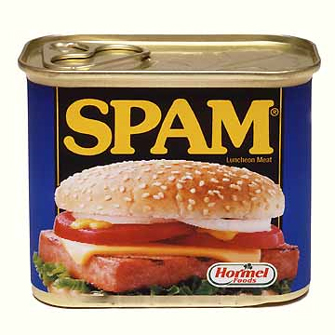
Spam. Not to be confused with Spammers. Not sure how processed meat became the go-to word for unsolicited email and social media harassment.
Spammers ruin the good intent that so many companies have when venturing into social media. Social media is an incredible opportunity to engage and interact with your customers, leads, employees, and even business partners. When someone decides to become a fan of yours on Facebook, decides to follow you on Twitter, or subscribes to your blog, it's because they think your messages are entertaining, interesting, intriguing or worth aligning themselves with. They are essentially offering their loyalty. They are willing to publicly acknowledge a tie to your organization to their personal connections. That's HUGE.
Unfortunately, along with the companies like Buffalo Wild Wings, who use social media to have fun with their customers, there are companies or independent "experts" who force their opinion and pour their useless information all over you. This is when there is a huge difference between interacting and selling online. The people who are truly successful building an online community are not forcing their opinion. They are doing their best to put out interesting content, interacting on a one to one basis and making their company worth interacting with. Ultimately, their fun little online community will visit their website, go to their store, set up a sales call. These relationships do lead to customers and to income. But you're going about it in a different way.
The people on Twitter who "follow" everyone in the hopes that they will get "followed" back are spammers and as a result, are following 25,000 and have only 300 followers. The people who send out updates on Facebook every 15 minutes urging you to go to their website and buy something are spammers. People whose blog is nothing more than an online sales pitch are spammers. Spammers ruin the reputation of legitimate marketers who are trying to build an online community. Don't fall into the dangerous rut of becoming a spammer yourself. And if you are genuine about your intent to build an online community, heed my warnings. Don't ruin inbound marketing for the rest of us.
Monday, December 7, 2009
Being Comfortable with Going Viral
It is amazing how a clever idea in a small corner of the online world can spread like wildfire and become an internet sensation. It is the best example of why social media and inbound marketing are essential to any organization's marketing strategy. But is can also be a warning to how important it is to closely monitor your online "reputation," so to speak, because it can quickly go from stellar to sleazy.
There are thousands of examples of how a great idea can run wild. Look at the Day at the Office video, the Whopper Sacrifice Facebook application, or the Dancing Wedding Party video. All of these internet phenoms had no idea the impact their content would have. And in the case of the lip syncing office and dancing wedding party, their goal was probably nothing more than having a good time and sharing it with a few friends. And really, that's the basis of this entire concept.
Going viral hinges on the fact that great ideas take off with just a little push from its creators. If you have the creativity to put together something truly clever, meaningful, or funny, it has the immediate opportunity to jump out of your hands and into the hands of the many individuals each day who patrol the world wide web for new content.
The idea that things can travel so fast is inspiring. It's amazing to see the impact that new ideas can have. And for organizations, it's exciting to know that something you created resonated so strongly with people outside your business that they cared enough to not only look at it themselves but to pass it on. It is the ultimate compliment. And it is what makes relationship based marketing so fun.
Many companies, however, hesitate to open themselves and their ideas up to the online world. Because opening yourself or your business up makes you vulnerable to the negative as much as the positive. You may experience some negative reactions as well as good. You do run the risk of your online reputation getting shaky. These concerns are valid. The brand image your company maintains is very valuable, and you wouldn't want to do anything that could ruin your hard work. But ultimately, I think these worries are far outweighed by the possible successes you could experience.
The internet is a forgiving place. And with new content available so often, if you do happen to crash and burn in your first couple attempts to create a video, a blog entry, or an online following it doesn't mean your online corporate life is over. It takes time to find the right mix of online content. It takes time to find the best way to reach out to your current and potential customers in a fun and engaging way. And it is very likely that at some point something you create will not work. And that's OK. Don't let the worry prevent you from trying it.
Going viral can be an exhilarating as it can be intimidating. But giving it a try is the best new way for your organization, or you personally, to create a new way to reach out to those around you.
There are thousands of examples of how a great idea can run wild. Look at the Day at the Office video, the Whopper Sacrifice Facebook application, or the Dancing Wedding Party video. All of these internet phenoms had no idea the impact their content would have. And in the case of the lip syncing office and dancing wedding party, their goal was probably nothing more than having a good time and sharing it with a few friends. And really, that's the basis of this entire concept.
Going viral hinges on the fact that great ideas take off with just a little push from its creators. If you have the creativity to put together something truly clever, meaningful, or funny, it has the immediate opportunity to jump out of your hands and into the hands of the many individuals each day who patrol the world wide web for new content.
The idea that things can travel so fast is inspiring. It's amazing to see the impact that new ideas can have. And for organizations, it's exciting to know that something you created resonated so strongly with people outside your business that they cared enough to not only look at it themselves but to pass it on. It is the ultimate compliment. And it is what makes relationship based marketing so fun.
Many companies, however, hesitate to open themselves and their ideas up to the online world. Because opening yourself or your business up makes you vulnerable to the negative as much as the positive. You may experience some negative reactions as well as good. You do run the risk of your online reputation getting shaky. These concerns are valid. The brand image your company maintains is very valuable, and you wouldn't want to do anything that could ruin your hard work. But ultimately, I think these worries are far outweighed by the possible successes you could experience.
The internet is a forgiving place. And with new content available so often, if you do happen to crash and burn in your first couple attempts to create a video, a blog entry, or an online following it doesn't mean your online corporate life is over. It takes time to find the right mix of online content. It takes time to find the best way to reach out to your current and potential customers in a fun and engaging way. And it is very likely that at some point something you create will not work. And that's OK. Don't let the worry prevent you from trying it.
Going viral can be an exhilarating as it can be intimidating. But giving it a try is the best new way for your organization, or you personally, to create a new way to reach out to those around you.
Wednesday, October 28, 2009
Don't Suck
I had the privilege to attending a webinar on advanced marketing analytics, hosted by the amazing Avinash Kaushnik yesterday and was absolutely blown away. Avinash had incredibly harsh and amazing ideas to help dig for valuable information in the garbage pile of data that is often available through web analytics. The whole webinar was awesome, and if you ever have the chance to hear Avinash speak I highly recommend it. But here is what I left with; the thought that has been echoing in my brain and pushing me to think in new ways ever since: Don't Suck.
Avi (my new, personal pet name for him) emphasized again and again the same idea thing that I have complained about but never really focused on for years: websites are too often designed around what the company wants to share, not what the visitor wants to see. And while some might argue that the two are one in the same, they are absolutely not.
Think of the last time you visited a website, for any reason, that you immediately left. I have done it numerous times. I use Google a thousand times a week, searching for content, ideas, material, competitors, etc. And so often I come across a website that is so useless; that offers so little of what I'm looking for, even though I know somewhere deep inside their matrix of a crap-shoot is valuable information, that I leave without a moments thought.
It all comes back to that same simple idea: Don't Suck.
Eliminate all the Gobbledygook from your website, copy or visual, and find ways to interact with your visitors, not "sell" to them. No one wants to be sold to. It's not fun. You feel uncomfortable, bullied, and annoyed. Give your visitors what they want: meaningful, valuable information they can use. And if you build a relationship of trust with them, promising again and again that you don't suck, and that you are here to provide them with what they are looking for without asking for their immediate payment in return, they will become your customer. Not only that, but they will become loyal, vocal customers of yours. Which is what we all need.
This entry is more of a brainstorm for me than it may be valuable for you. But it is something worth thinking about. I'll follow up when I have more to offer on the subject. But in the meantime, how have you made sure your website doesn't suck?
Avi (my new, personal pet name for him) emphasized again and again the same idea thing that I have complained about but never really focused on for years: websites are too often designed around what the company wants to share, not what the visitor wants to see. And while some might argue that the two are one in the same, they are absolutely not.
Think of the last time you visited a website, for any reason, that you immediately left. I have done it numerous times. I use Google a thousand times a week, searching for content, ideas, material, competitors, etc. And so often I come across a website that is so useless; that offers so little of what I'm looking for, even though I know somewhere deep inside their matrix of a crap-shoot is valuable information, that I leave without a moments thought.
It all comes back to that same simple idea: Don't Suck.
Eliminate all the Gobbledygook from your website, copy or visual, and find ways to interact with your visitors, not "sell" to them. No one wants to be sold to. It's not fun. You feel uncomfortable, bullied, and annoyed. Give your visitors what they want: meaningful, valuable information they can use. And if you build a relationship of trust with them, promising again and again that you don't suck, and that you are here to provide them with what they are looking for without asking for their immediate payment in return, they will become your customer. Not only that, but they will become loyal, vocal customers of yours. Which is what we all need.
This entry is more of a brainstorm for me than it may be valuable for you. But it is something worth thinking about. I'll follow up when I have more to offer on the subject. But in the meantime, how have you made sure your website doesn't suck?
Wednesday, September 30, 2009
More Than Status Updates...Why Social Media is an Essential Part of Any Marketing Plan
Taking the first step to incorporating social media into your organizational marketing plan can be an intimidating one. For businesses that have never made use of this new medium as a way to reach out to their clients, leads and communities, it can even seem irrelevant. How can social media possibly play a role in {insert industry name here}? It's a common question, and a reasonable one at that. Social media is becoming an essential element to any marketing strategy, but the key is finding the ways it best relates to your business and to those you're trying to reach. There is no cookie-cutter form that social media can take in your overall strategy.
Your best start, as with any new marketing initiative, is to understand what you hope to get out of this venture. Would you like social media help you build stronger relationships with existing clients? Reach out to potential customers? Build a more prominent image of your business within your community or industry? All of these are potential outcomes, but tailoring your purpose will help you find a starting place.
The next step you'll need to take into Social Media 101 is changing your perspective on strategy entirely. Social media encompasses an entirely new approach to marketing, far different from anything your print ads, direct mail campaigns or other traditional mediums capture. Social media focuses on inbound marketing - you are inviting those who might express an interest in your company to come to you, on their own terms, and seek out their own information. And for a new generation of potential clients, this is ideal. Interruption-based marketing is just that - based on the opportunity to interrupt people's daily lives and force a message on them. Inbound marketing requires that you provide those seeking you out with immediate, relevant information in an way that is easy to access, and fun! You are building a relationship with these contacts rather than making a sales - and that is far more valuable.
There is a plethora of options when you dive into the social media world, and each has its own unique niche.
Facebook is an opportunity build relationships by giving your organization a personality. Invite your "fans" to events, encourage and monitor discussion, post photos, and give those you interact with some ownership in the direction that your Facebook page, and even your organization takes. Facebook gives you the chance to really engage your fans and let them know that you are listening. And status updates give you the opportunity to offer frequent updates or messages to those you are connected with, even if it's just a quick call-out to remind them you're there.
LinkedIn allows you to build professional relationships with colleagues, other businesses in your industry, employees and potential employees. The Answers section provides outreach for individuals within your organization who may want to seek advice about a particular situation. Build a page to represent your organization, and allow your employees to proudly link to it, and demonstrate to others their pride in their employer.
Twitter is a relevant tool if you have frequent, quick updates to offer your "followers." Giving you only 140 characters to mini-blog with, it can be limiting, which is why it is essential to establish whether Twitter can be used to generate any valuable results. It is my personal opinion that Twitter can only be fully successful for a small window of business. For instance, the New York Times can post headlines and a call out to articles, which provides those who follow them the opportunity to interact with the online newspaper when a topic gathers their interest. It would not be as successful for your organization if you don't have frequent, concise messages to share. Twitter is a hot trend now, but it's hard to say what kind of longevity it will have without some changes in its platform.
MySpace, the former leader of the social media world, and somewhat fallen off the map. After establishing itself as the leader of the online networking craze, Tom and his followers have slowly become overwhelmed with spam and junk. While still a strong tool for musicians, aspiring actors and the like, organizations may not find it as valuable, and may have to weed through a whole lot of mess to get to any true value. While I don't recommend the site as a tool in your marketing plan, it doesn't hurt to take a look and see where social media came from and where it is today.
Blogging, utilizing WordPress or Blogger, among others, is another tool that has become a craze. As a blogger myself, I definitely see the value in it, as do hundreds of others. This tool can be easily utilized by many people, where you can share whatever information you want. The important piece that is all too often forgotten is whether what you're saying is meaningful to others. Remember, we are dealing with inbound-based marketing. An electronic sales pitch won't work. You need to be using your blog to provide valuable and relevant information to those reading it that will eventually lead to a sale or new client. No one will intentionally seek out your blog if each time they read it they are bombarded with a pitch. If, however, you present well thought out answers to common questions your customers have, you suddenly position yourself as an expert and a resource. And that is something each of your current and potential clients will see value in.
Social media is a maze that is difficult to navigate. But it is worth the work if you can find a way to implement it and form relationships with those you want to reach out to. Don't feel like you need to tackle it all at once. Pick an entry point - create a Facebook page, or a LinkedIn business profile. Become comfortable with that one piece, and then build on it. If you dive in head first with all these mediums, and the many others that are out there, you will quickly find yourself falling to the 5,697 page of Google search results.
Tuesday, July 21, 2009
Does Twitter Have Actual or Perceived Value?
I will preface this entry by saying that I love new technology, new marketing outlets, new opportunities to reach out to potential customers. Having said that, I think it is time we all took a good, hard, REALISTIC look at Twitter.
Twitter introduced to the world the concept of micro-blogging. It offers the opportunity to send short, frequent updates to the myriad of "followers" you have acquired throughout the site. Here are the shortcomings I see from the site:
1. The Epitome of Self Indulgence
For most of the users, Twitter leads you to believe that all of your followers care what you are doing at any given moment of the day. Updating us that you just got off the bus, are heading to Starbuck's, and then off to your first meeting of the day isn't necessary breaking news, or anything that we care to hear about. I often wonder if Twitter is just fertilizer to individual egos. "Oh, I just found a dollar on the sidewalk! Where's my cell phone? My followers must hear about this!"
2. More About "Followers" Than "Following"
To me it seems like Twitter is walking down the dangerous path that MySpace ended up on. Rather than creating valuable connections where info, notes, updates, even jokes can be passed, it is becoming a contest of who can collect the most followers. It is basic Twitter etiquette that you follow someone who has decided to follow you. But what percentage of your followers are actively engaged in what you are posting, and what percentage are just upping the number of followers to gain notoriety in the Twittersphere?
3. What Are You Getting Out of It?
My biggest concern is this: while the functionality of Twitter is fascinating, and I myself explore its possibilities, I again and again run into the question of what am I actually getting out of Twitter? Is this expanding my network of professional relationships? Is this going to help generate leads for my organization? I ask these questions frequently, and keep coming back with "no".
I do see some Twitter-ers who are using their accounts in a meaningful way to interact with others, and maybe that will evolve and make the site more impactful. But as of now, I worry that it is nothing more than an online popularity contest.
What are your thoughts? What have you seen? Does Twitter have long-term potential or will it fade away?
Why Direct Mail is Still Relevant
In the crazy universe that is social media, Facebook, Twitter, and the like have overtaken the attention of marketing professionals everywhere. We are all guilty of jumping on the social media bandwagon. Not that it is a bad thing - social media has a very significant role in organizations today, and it offers a new and unique way to reach out to potential customers, referral sources, and other professionals. But left in the dust of the new generation of marketing is an often forgotten attempt: direct mail.
Don't get me wrong; I'm not encouraging you to buy one million white envelopes, fill them with a form letter and start flooding your contacts and leads with boring letters. That is not at all the case. But direct mail still plays a vital role in customer and lead communication. The tricky part is to find the right way to do it.
Personally, I hate junk mail. I hate mass mailed letters from my local cable company that doesn't even have my name on it; it is addressed to "Occupant" or "Resident". Those suck, and they make me dread opening my mail. This, of course, is not direct marketing.
Here is where the opportunity lies: I love getting actual mail. Packages, thick envelopes, self-mailers in crazy shapes. I'm fascinated by them. And I get small ego boost when I know that an organization has spent the time and money to create a piece especially for me. My thought process from there was that I can't be the only person in the world that loves getting real, actual, substantial mail. Think of how excited you get when your latest issue of {insert your favorite publication here} arrives in the mail. Don't you look forward to receiving the pair of shoes you ordered from Zappos? The same approach can be taken with direct marketing.
In one of my past lives as a marketing professional, I created a direct mail campaign for our business clients. Renewal rates were very low, our client turnover was significant. We didn't have an engaging relationship with our clients. But rather than send their account manager over to badger them AGAIN about renewing their contract, or sending them a boring letter in a boring envelope to bore them about our boring new contract terms.
INSTEAD, I worked with an amazing marketing firm to develop a five-drop mailing campaign to re-engage them with our organization. Each mailer was a box, about 5" x 3" x 3. Within each box was a toy, and each toy had a tie-in to a reason that we were the best company to serve them. A slinky to show our flexibility to meet their needs, a small set of Legos to show we could build a service plan to fit their needs, etc.
The goal of this campaign was not to instigate phone calls, or to force them to reach out to us. It was to open the door to a conversation, and to get them to see us not as a stuffy organization selling them a service, but a company that enjoyed what they do and wanted our clients to enjoy working with us. And the results were stellar.
Our account managers began getting phone calls after about the second mailer, with clients eagerly awaiting the next package. When our AMs were out meeting with clients, the toys were sitting out on their desks, proudly displaying our logo. We were doing more than selling to these people - we were building a relationship. And engaging them in a way that no one had before.
I'm not saying this scenario can be successful in every circumstance. But I think there is definite opportunity in taking a traditional form of outreach and finding a new and dynamic way to utilize it.
I'd love to hear about your success stories in this medium.
P.S. I do not work for any direct mail or marketing agency, so this is not meant to be a sales pitch. Just me, sharing.
Subscribe to:
Comments (Atom)